
Play Le Pharaoh Now!
Home → Strategy
Le Pharaoh Strategy
Approaching Le Pharaoh sensibly
The theoretical RTP of 96.18% for Le Pharaoh establishes a baseline expectation for high rollers seeking long-term value against the house edge of 3.82%. This percentage represents a mathematical average over hundreds of thousands of spins, meaning short-term results will deviate significantly from this return rate. Players must recognize that volatility determines the frequency and size of payouts rather than the overall profitability of the session. Consequently, bankroll management becomes more critical than game selection when aiming to sustain play through inevitable dry spells.
Le Cowboy offers a slightly higher RTP of 96.28%, providing a marginal statistical advantage compared to the 96.18% found in Le Pharaoh. However, the maximum win potential of 25000x in Le Cowboy contrasts sharply with the 15000x cap available in the Egyptian-themed slot. High rollers often prioritize the higher ceiling despite the lower return percentage, accepting the increased risk for a chance at larger payouts. This trade-off requires a disciplined approach to stake sizing to avoid rapid depletion of funds during extended losing streaks.
Hacksaw Gaming designs Le Pharaoh with a medium volatility profile, balancing the frequency of wins against the size of the payouts across its six-reel layout. The presence of Sticky Re-Drops adds complexity to the base game, influencing how often players can expect to trigger bonus features or significant wins. Understanding these mechanics helps players set realistic expectations for their session duration and potential return on investment. Ignoring the specific feature set may lead to misjudging the actual cost per spin required to achieve meaningful results.
Bankroll rules that hold up
A dedicated bankroll for Le Pharaoh should cover at least 500 spins to withstand the variance inherent in its medium volatility setting. With a typical high roller stake of 10 € per spin, this requirement translates to a minimum starting balance of 5000 € to ensure sufficient playtime. This rule prevents premature ruin during normal fluctuations and allows the theoretical RTP of 96.18% to have a chance to manifest over time. Without this buffer, even small losing runs can eliminate the entire fund before any significant winning sequences occur.
The maximum win cap of 15000x in Le Pharaoh defines the upper limit of potential profit from a single session or feature trigger. For a player betting 10 € per spin, hitting this cap yields a gross payout of 150,000 €, which drastically alters the total return for that day. Tracking this figure helps players understand the absolute ceiling of their exposure versus their potential reward in any given round. Exceeding this amount is impossible regardless of subsequent spins, making it a crucial reference point for evaluating session success.
Comparative analysis shows that Le Cowboy allows for a higher maximum win of 25000x, offering a greater upside potential for those willing to accept similar volatility risks. While Le Pharaoh caps at 15000x, the difference in payout structure influences how high rollers allocate their capital across different Hacksaw Gaming titles. A robust bankroll strategy accounts for these varying ceilings by adjusting stake sizes relative to the maximum possible payout of each specific game. This ensures that no single session poses an unacceptable risk to the overall financial plan established for gambling activities.
Bet sizing against volatility
Flat betting remains the most sustainable strategy for managing stakes in Le Pharaoh, ensuring that each of the 19 paylines receives consistent funding throughout the session. By maintaining a fixed wager, such as 5 € per spin, players avoid the pitfalls of progressive staking systems that increase risk without altering the built-in house edge. This method preserves the bankroll longer, allowing the medium volatility to play out naturally over a larger number of spins. It eliminates the emotional decision-making that often leads to rapid losses during perceived cold streaks.
The six-reel grid of Le Pharaoh requires careful consideration of bet levels due to the medium volatility setting that balances hit frequency with payout size. Increasing the stake beyond 10 € per spin accelerates the rate of bankroll depletion during non-winning spins, reducing the total number of spins affordable. Conversely, lowering the bet to 0.20 € extends playtime but significantly diminishes the impact of any major wins triggered by Sticky Re-Drops. Finding the optimal stake involves calculating the cost per hour based on expected spin speed and desired session length.
Le Cowboy presents a different risk profile with its 25000x max win, suggesting that high rollers might adjust their bet sizing to capitalize on higher potential payouts. While Le Pharaoh limits wins to 15000x, the choice between games often depends on whether the player prefers frequent smaller wins or rare massive jackpots. Adjusting bets according to the specific volatility and win cap of each title ensures that the risk taken is proportional to the potential reward. This tailored approach helps maintain discipline and prevents overexposure to variance in any single gaming session.
Session limits worth setting
Setting a strict time limit for playing Le Pharaoh helps prevent fatigue-induced errors and maintains focus on responsible gambling practices during high-stakes sessions. A typical session of two hours with 10 € bets results in a turnover of approximately 1200 €, assuming an average spin speed of one second. This calculated exposure ensures that players do not exceed their pre-determined budget while still engaging sufficiently with the game features like Sticky Re-Drops. Time-based limits complement financial controls by adding another layer of protection against impulsive decision-making.
The theoretical RTP of 96.18% implies that over a very long run, the house retains 3.82% of all wagers placed on Le Pharaoh. Recognizing this mathematical reality encourages players to view losses as the cost of entertainment rather than an investment opportunity requiring recovery. Setting a loss limit equal to 50% of the initial bankroll provides a clear exit point if luck turns unfavorable during the session. This proactive measure prevents chasing losses and helps preserve remaining funds for future, more strategically planned gaming activities.
Comparing session outcomes with Le Cowboy, where the max win reaches 25000x, highlights the importance of defining what constitutes a successful session for each specific game. In Le Pharaoh, achieving a 15000x multiplier represents a significant victory, whereas players targeting Le Cowboy might expect much larger returns. Defining success metrics beforehand helps manage expectations and reduces frustration when results fall short of ambitious goals. This clarity supports better emotional control and adherence to predetermined stopping points during gameplay.
Why chasing losses fails
Chasing losses in Le Pharaoh violates the fundamental principle that each spin is independent and unaffected by previous outcomes on the six-reel grid. Increasing stakes after a deficit does not improve the odds of hitting the 15000x max win, as the RNG ensures random results every single time. This behavior typically accelerates bankroll depletion, turning manageable losses into catastrophic financial damage within a very short period. Accepting the outcome of each session is essential for maintaining long-term sustainability in high-stakes online gaming environments.
The medium volatility of Le Pharaoh means that losing streaks are a natural and expected part of the gameplay experience, regardless of the chosen stake level. Attempting to recover these losses by raising bets ignores the fact that the house edge of 3.82% remains constant across all wager sizes. This strategy only increases the variance of results, leading to higher peaks and deeper troughs in the bankroll curve. Sustainable play requires sticking to the initial bankroll rules and avoiding reactive adjustments based on temporary setbacks.
Le Cowboy offers a higher max win potential of 25000x, which might tempt players to chase deficits hoping for a similarly large payout in Le Pharaoh. However, the lower 15000x cap in Le Pharaoh makes recovering significant losses statistically more difficult compared to games with higher multipliers. Relying on luck to reverse trends is a flawed strategy that disregards the mathematical certainty of the house advantage over time. Discipline in maintaining fixed bet sizes protects the bankroll from the inevitable downsides of emotional decision-making.
Le Pharaoh: key facts
| Parameter | Value |
|---|---|
| Game | Le Pharaoh |
| Studio | Hacksaw Gaming |
| RTP | 96.18% |
| House edge | 3.82% |
| Volatility | medium |
| Max win | 15000x |
| Reels | 6 |
| Paylines / ways | 19 |
Common systems and their limits
Hacksaw Gaming developed Le Pharaoh with a 96.18% RTP, establishing a theoretical return that high rollers must respect over extended sessions. This figure represents the long-term average across hundreds of thousands of spins rather than a guarantee for any single visit. Consequently, players should allocate a substantial bankroll to withstand inevitable variance without depleting funds prematurely. The house edge of 3.82% remains constant regardless of betting patterns or stake adjustments made during play.
Le King by Hacksaw Gaming offers a 96.14% RTP alongside a higher maximum win potential of 20000x compared to Le Pharaoh's 15000x cap. While both titles share medium volatility, the slight difference in return percentages influences the expected loss rate per thousand euros wagered. High stakes players often compare these metrics to determine which game offers better value retention over a prolonged gaming session. Such comparisons help manage expectations regarding the sustainability of large betting strategies against the built-in mathematical advantage.
Flat betting explained
Flat betting requires maintaining the same stake every round, ensuring consistent exposure to the 96.18% RTP defined by Hacksaw Gaming for Le Pharaoh. This strategy prevents rapid depletion of the bankroll by avoiding the emotional spikes associated with increasing bets after losses. Players utilizing this method can extend their playing time significantly, allowing more opportunities to trigger the Sticky Re-Drops feature. The predictable nature of fixed stakes helps high rollers monitor their expenditure accurately throughout the session.
Progressive staking risks
Progressive staking involves raising stakes after losses, a tactic that does not alter the 3.82% house edge inherent in Le Pharaoh by Hacksaw Gaming. Increasing wagers during losing streaks accelerates the rate at which the bankroll is consumed, shortening the overall duration of play significantly. High rollers attempting this approach often face ruin faster because the mathematical disadvantage compounds with larger bet sizes. The 15000x max win remains unreachable if funds are exhausted before hitting a lucky sequence of sticky drops.
What the maths actually allows
Theoretical calculations based on a 96.18% RTP suggest that Le Pharaoh returns €96.18 for every €100 wagered over an infinite number of spins. This percentage excludes other configurations like 94.33% or 88.24%, which might exist but reduce player returns further in specific instances. Understanding these figures helps high rollers anticipate potential losses when targeting the 15000x maximum win cap offered by the game. The medium volatility ensures that wins occur regularly enough to sustain engagement without extreme dry spells draining accounts quickly.
Reading variance honestly
Medium volatility in Le Pharaoh means payouts occur with moderate frequency, balancing small wins against the rare chance of hitting the 15000x multiplier. Hacksaw Gaming designed the 6-reel layout to provide diverse winning combinations across the 19 paylines, affecting how variance manifests during gameplay. High rollers must recognize that even with a 96.18% RTP, short-term results can deviate significantly from the theoretical expectation. Accepting this reality prevents chasing losses and encourages disciplined management of the allocated bankroll throughout the session.
Learning the game in demo first
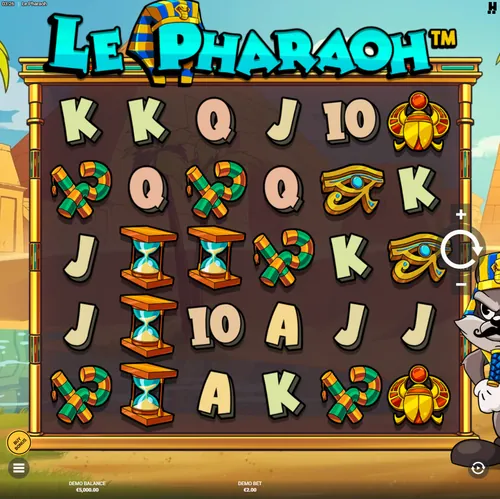
Le Pharaoh is a six-reel, five-row slot developed by Hacksaw Gaming that utilizes 19 paylines. The grid structure differs from traditional five-reel formats, requiring players to adapt their visual scanning for the Sticky Re-Drops feature. This layout change affects how winning combinations form across the central symbols during base play.
The theoretical return (RTP) stands at 96.18%, which represents the long-term percentage of wagered money returned to players. Other configurations circulate at 94.33%, 92.26%, and 88.24%, creating significant variance in expected returns. Players must verify the specific version before depositing to avoid unexpected house edges.
Wanted Dead or a Wild offers a slightly higher RTP of 96.38% from the same developer. Comparing these two titles highlights the importance of checking individual game settings rather than assuming uniformity. Le Pharaoh's medium volatility suggests more frequent but smaller payouts compared to high-variance alternatives.
Adjusting stakes to your budget
The maximum win potential for Le Pharaoh is capped at 15000x the total stake amount. This multiplier applies to the final payout after all features, including Sticky Re-Drops, have resolved. High rollers targeting this cap must ensure their bankroll can sustain the necessary volume of spins.
Flat betting involves maintaining the same stake every round to manage variance predictably. Progressive staking raises stakes after losses, which does not change the built-in edge and only shortens the time to ruin. Mathematical models show that fixed wagers preserve capital longer against the 3.82% house edge.
A 300% welcome bonus up to €2,000 plus 100 free spins provides additional playing capital. Bonuses increase the total bankroll available for testing strategies without immediate personal risk. Players should calculate the effective stake size relative to the bonus terms to maximize value extraction.
Recognising a bad session
Medium volatility indicates that losing streaks are common but typically shorter than in high-variance games. A session lasting hundreds of spins with no major hits suggests the RTP is performing near its theoretical minimum. Tracking the ratio of spins to small wins helps identify when variance is working against the player.
The house edge of 3.82% ensures that every spin contributes to long-term negative expectancy. If the balance drops below 50% of the initial bankroll within a few hundred spins, the session is statistically unfavorable. Continuing under these conditions usually accelerates depletion due to the mathematical inevitability of the edge.
Wanted Dead or a Wild has a max win of 12500x, slightly lower than Le Pharaoh's 15000x cap. This difference matters less during dry spells where volatility dominates short-term results. Recognizing that no strategy overcomes the edge prevents chasing losses on either title.
Stopping while ahead
Hit frequency determines how often winning combinations appear on the reels during base play. Le Pharaoh's medium volatility suggests moderate hit rates, allowing for periodic bankroll replenishment. Securing profits after a lucky streak preserves gains against the inevitable regression to the mean.
The 15000x max win cap limits the upside potential regardless of how many sticky symbols align. Once a significant portion of this cap is approached, the risk-reward ratio shifts negatively. Exiting before hitting the absolute maximum avoids giving back winnings during extended play.
Bonus rounds and free spins can extend session length without additional cost to the player. These features often provide the highest concentration of value within a single session. Cashing out after utilizing free spins locks in the generated profit before returning to risky base game stakes.
Responsible play in practice
Bankroll management requires setting aside a fixed amount of money designated solely for entertainment expenses. Treating this fund as lost income eliminates emotional attachment to outcomes during gameplay. Le Pharaoh's 19 paylines require careful stake sizing to prevent rapid erosion of this dedicated pool.
The theoretical return of 96.18% guarantees that the casino retains 3.82% of all wagered money over time. This statistical certainty makes professional gambling impossible for the average player seeking consistent income. Accepting this reality helps maintain realistic expectations about wealth generation through slots.
Self-exclusion tools and deposit limits provide structural safeguards against impulsive decision-making. These mechanisms enforce boundaries that human willpower often fails to maintain during hot streaks. Utilizing these features ensures that Le Pharaoh remains a controlled leisure activity rather than a financial liability.
DemoRTP & VolatilitySymbols & PayoutsBonus FeaturesStrategyBonusesMobileDownload & AppMax WinSimilar GamesReviewFAQSitemap
Le Pharaoh 2026